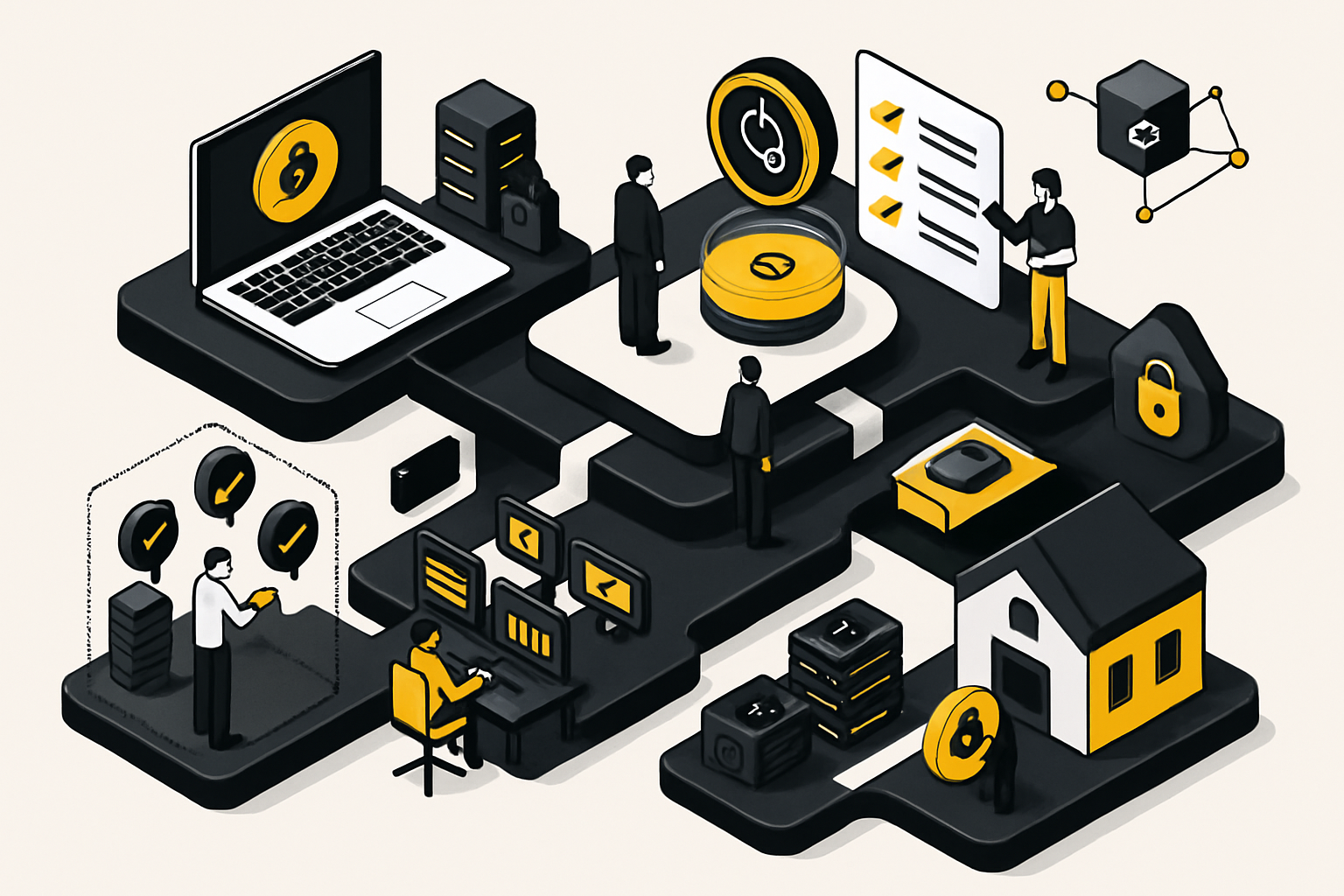
In 2025, DAOs are under immense pressure to strike a practical equilibrium between transparency and confidentiality. Community trust hinges on visible, auditable governance, yet operational security and regulatory realities demand robust privacy controls. Market leaders are not choosing one or the other; instead, they are engineering hybrid governance architectures that leverage cryptographic advances to deliver both. Below, we examine three actionable strategies that confidential DAOs are deploying to meet these dual demands.
Hybrid Governance Models with Role-Based Transparency
Traditional DAOs often defaulted to fully public voting and proposal systems. This approach maximized transparency but exposed sensitive data and made personal or strategic decisions vulnerable to external manipulation. In 2025, the most resilient organizations adopt hybrid governance models with role-based transparency. These frameworks combine open, on-chain voting for general proposals with confidential decision-making for sensitive matters such as treasury management or HR issues.
The technical backbone of this model is permissioned access: specific roles (like stewards or compliance officers) can participate in confidential votes using zero-knowledge proofs (ZKPs) to validate eligibility without revealing identity or vote content. For example, a DAO may use on-chain voting for budget allocations but restrict contract negotiations to a smaller group whose actions are logged but whose deliberations remain private. This approach maintains community trust while shielding proprietary data from adversaries.
For more on how confidential governance protects DAOs from manipulation and coercion, see this practical guide.
QOC Decision-Making Enhanced by Cryptographic Tools
The QOC (Questions, Options, Criteria) framework has emerged as a leading methodology for structuring DAO decisions transparently while respecting participant privacy. QOC breaks down proposals into clear questions with predefined options and explicit evaluation criteria. The real innovation in 2025 is the integration of advanced cryptographic tools, such as homomorphic encryption or zk-SNARKs, at each stage of the process.
Here's how it works: Each member submits their vote privately via an encrypted channel; cryptographic protocols aggregate these votes without ever exposing individual choices. Only the final tallies and rationale are published on-chain for full auditability. This ensures that even as DAOs open their decision process to scrutiny, no single member’s preferences or affiliations are leaked, a vital protection against bribery or retaliation.
This blend of structured transparency and cryptography is enabling DAOs to operate at scale without sacrificing privacy in decentralized organizations.
Modular Privacy Protocols for Mixed Asset Governance
DAOs managing both digital tokens and physical assets face unique confidentiality challenges, asset locations, valuations, and custodial arrangements must be shielded from public view without undermining stakeholder oversight. The solution gaining traction is deploying modular privacy protocols tailored to asset types.
Confidential smart contracts act as selective shields: sensitive data fields (such as GPS coordinates of physical assets or details of off-chain agreements) are encrypted at rest and only accessible by authorized parties through verifiable credentials. Meanwhile, all governance actions, proposals submitted, votes cast, outcomes achieved, remain auditable by stakeholders via transparent logs.
This modular approach gives DAOs granular control over what remains private versus what is disclosed, a key advance over monolithic privacy solutions that often hampered operational flexibility in earlier years.
By leveraging these modular privacy protocols, DAOs can confidently expand into real-world asset management, decentralized finance, and cross-jurisdictional operations without exposing critical business intelligence or participant identities. Stakeholders retain full visibility into governance processes while sensitive operational data remains shielded by cryptographically enforced access controls. For a technical deep dive on how granular privacy can be implemented in DAOs, refer to this guide.
Best Practices and Implementation Considerations
While the strategies above provide a robust framework for balancing transparency and confidentiality, effective implementation requires more than just technical integration. DAO architects should:
- Continuously audit cryptographic primitives: Ensure that zero-knowledge proofs, encryption schemes, and confidential smart contracts are up to date with current threat models.
- Define clear role-based permissions: Explicitly delineate who has access to confidential processes and under what conditions, updating governance charters as roles evolve.
- Document decision logic transparently: Even when details are shielded, publish high-level rationales and aggregated outcomes to maintain community trust.
- Engage in regular security reviews: Periodically test both the technical stack and operational workflows for vulnerabilities or unintentional data leaks.
Adoption of hybrid governance models, QOC frameworks with cryptographic enhancements, and modular privacy protocols is accelerating among leading confidential DAOs in 2025. These approaches enable organizations to remain agile and compliant while preserving the core ethos of decentralized transparency. As regulatory scrutiny increases and the value of on-chain assets grows, expect further innovation at the intersection of privacy engineering and participatory governance.
The future of DAO confidentiality will be shaped by ongoing advances in secure multiparty computation, verifiable credentials, and customizable privacy layers. For those building or participating in next-generation DAOs, embracing these actionable strategies is not just a best practice, it’s a prerequisite for resilient decentralized operations in an increasingly complex ecosystem.




No comments yet. Be the first to share your thoughts!