

In the evolving landscape of decentralized governance, DAOs face a critical challenge: managing payroll without compromising contributor privacy. Public blockchains expose wallet addresses, salary amounts, and transaction histories, inviting risks from doxxing, targeted attacks, and regulatory scrutiny. Confidential DAO payroll solutions emerge as a necessity, enabling secure DAO contributor payouts that shield sensitive data while upholding transparency in governance.

Key Risks of Public DAO Payroll
-
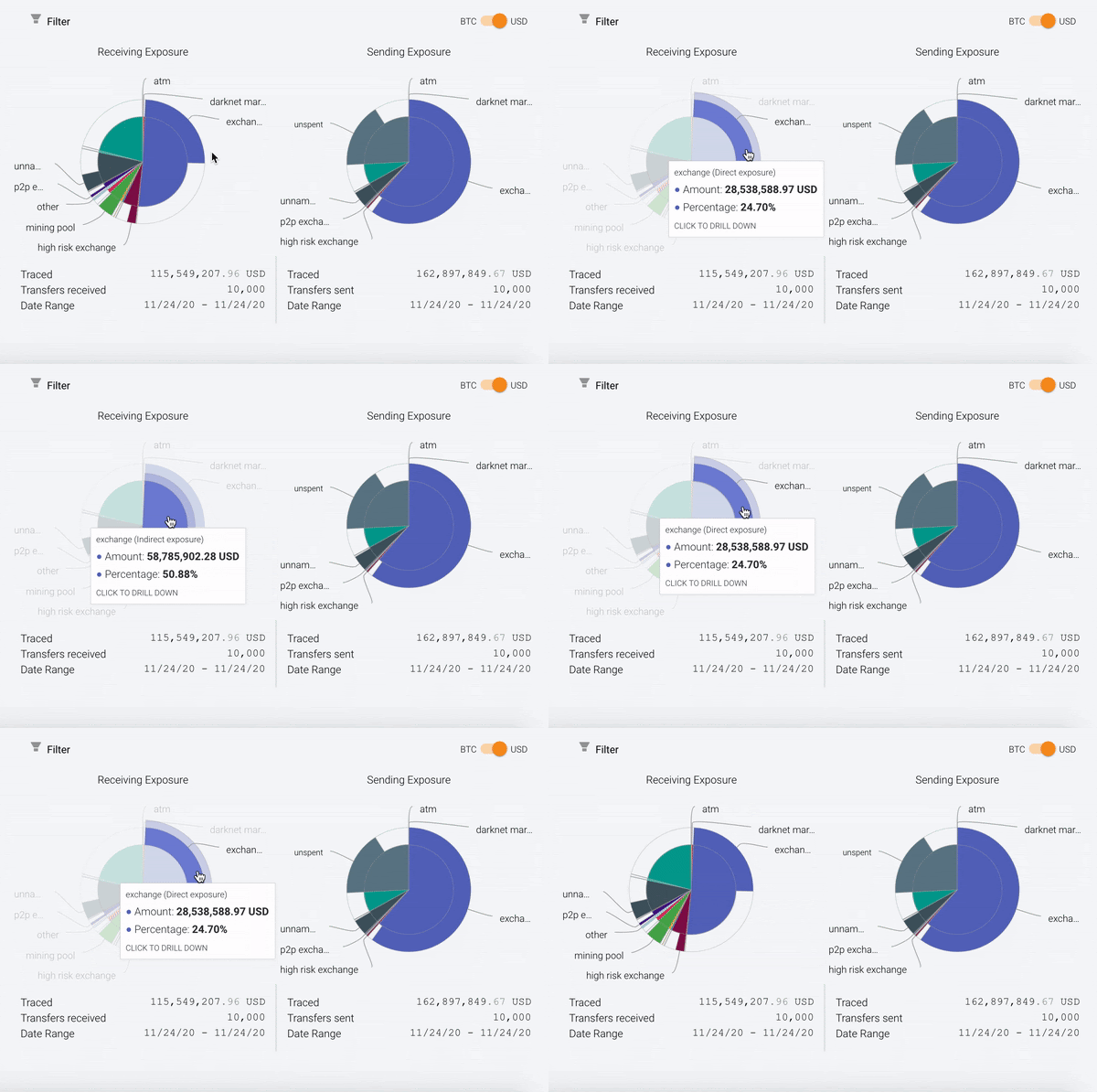
Wallet Exposure: Public on-chain transactions reveal contributor wallet addresses, allowing anyone to track spending patterns and personal finances.
-
Salary Leaks: Transparent payroll exposes individual compensation details, leading to internal disputes, poaching, or public scrutiny.
-
Regulatory Non-Compliance: Visible salaries and payments may violate data protection laws like GDPR, risking fines and legal challenges.
-
Contributor Doxxing: Linking wallets to identities enables doxxing, harassment, or targeted attacks on DAO members.
-

Treasury Vulnerabilities: Public payroll patterns expose treasury flows, aiding attackers in timing exploits or social engineering.
The Privacy Imperative in DAO Operations
Traditional payroll in DAOs relies on transparent chains like Ethereum, where every transaction is visible. This openness, while fostering trust, undermines individual privacy. Contributors hesitate to join when their earnings become public knowledge, potentially affecting negotiations or personal security. Recent trends, including heightened data protection laws, amplify these concerns. Platforms like Secret Network offer encrypted databases, allowing selective decryption for verified queries without full exposure. This shift toward programmable privacy DAOs balances collective accountability with personal discretion.
Consider the human element: a developer receiving payments in USDC sees their wallet linked across projects, painting a financial profile for anyone to analyze. Private DAO payments disrupt this by obscuring details on-chain. Insights from Web3Privacy Now highlight over 750 privacy projects, underscoring a maturing ecosystem ready for payroll integration.

Harnessing Zero-Knowledge Proofs for Verifiable Anonymity
Zero-knowledge proofs (ZKPs) stand at the forefront of DAO privacy payroll tools. These cryptographic primitives let a DAO prove a payroll batch totals correctly and reaches valid recipients, sans individual breakdowns. Imagine verifying that $100,000 in salaries distributed matches treasury outflows, without disclosing who earned $5,000 or $50,000. Implementations on networks like Aztec or via libraries such as Semaphore enable this seamlessly.
In practice, a DAO multisig approves encrypted proofs. Contributors submit ZK attestations confirming eligibility, triggering payments to shielded wallets. This method not only prevents front-running but also complies with standards like GDPR by minimizing data exposure. My experience structuring private syndicates shows ZKPs reduce audit friction, as verifiers gain assurance without invasive logs.
Confidential ERC20 and Beyond: Encrypted Payroll Streams
Building on ZKPs, Confidential ERC20 (cERC20) tokens leverage fully homomorphic encryption (FHE) for computations on ciphered data. DAOs can stream salaries via tools like Sablier, integrated with Safe multisigs, where balances and transfers remain opaque. Encryption persists through settlement, revealing only what governance demands.
Privacy platforms such as zkBob further enhance this, routing stablecoin payouts through mixers to obscure origins. No primary wallet links surface, mitigating re-identification risks. For global teams, this aligns with best practices from payroll security experts: encryption, access controls, and audits. Yet, balance is key; over-reliance on privacy tech demands robust off-chain contributor vetting to prevent abuse.
Off-chain vetting complements these tools, ensuring only trusted contributors access shielded streams. Drawing from payroll security guides like those from Remote and Papaya Global, DAOs should layer encryption with multi-factor authentication and regular audits. This multi-pronged defense mirrors traditional best practices, adapted for blockchain’s transparency paradox.
Layered Privacy Stacks: Integrating Tools for Robust Payroll
Effective confidential DAO payroll demands a layered approach. Start with Secret Network’s encrypted databases for storing contributor data, querying only decrypted aggregates for governance votes. Pair this with ZKPs for proof-of-payment validity and cERC20 for encrypted token flows. Platforms like zkBob handle the final leg, mixing stablecoin transfers to unlink them from DAO treasuries.
Sablier’s streaming integrates seamlessly with multisig wallets like Safe, automating secure DAO contributor payouts over time. A DAO sets up a stream: encrypted salary rate, duration, recipient proof. Funds vest privately, cliff conditions verifiable via ZK. This setup, seen in private syndicates I’ve advised, cuts administrative overhead while preserving discretion.
Comparison of DAO Payroll Privacy Tools
| Technology | Key Features | Pros | Cons | Use Case |
|---|---|---|---|---|
| ZKPs | Prove payment validity without revealing salaries or wallets | Verifiable anonymity, trustless verification, maintains transparency | Compute intensive, complex implementation | Verifying total payroll without exposing individual salaries |
| cERC20/FHE | Computations on encrypted data for balances and payments | Encrypted computation, instant settlement, regulatory compliance | High computational overhead, emerging technology risks | Encrypted payroll transactions in DAOs |
| zkBob mixer | Private stablecoin transactions (USDC, USDT, DAI) hiding recipient wallets | Easy integration, supports donations and payments | Mixer risks (regulatory scrutiny), potential centralization | Anonymous contributor payments without wallet exposure |
| Sablier streams | Automated streaming payments from multisig wallets like Safe | Real-time distribution, secure treasury integration | Limited inherent privacy (on-chain visibility unless combined with privacy tools) | Automating secure payroll streams in DAOs |
Web3Privacy Now catalogs over 750 projects, yet few DAOs deploy full stacks. The hesitation stems from complexity, but modular kits simplify adoption. For instance, combine Semaphore for signaling eligibility with Flashbots-style TEEs for execution privacy, as Aztec explores in ZK-MPC-FHE-TEE hybrids.
Regulatory alignment adds another layer. GDPR and emerging crypto rules favor minimal disclosure. Encrypted payroll satisfies this: totals public, details private. Audits via selective reveals build trust without leaks. In my projects, this has quelled contributor concerns, fostering loyalty in competitive talent markets.
Real-World Deployment: From Setup to Scale
Deployment begins with treasury assessment. Migrate to a privacy-enabled chain or L2 like Aztec. Contributor onboarding uses soulbound tokens or quadratic attestations for identity hints, sans doxxing. Payroll cycles: propose encrypted totals in governance, ZK-verify distributions, stream via Sablier.
Scale introduces challenges like oracle dependencies for off-chain salary computations. Trusted execution environments (TEEs) mitigate this, as Secret Network validators demonstrate. Yet, balance innovation with caution; LinkedIn experts warn of HR data pitfalls, urging clear policies on disputes and clawbacks in shielded systems.
Challenges persist: gas costs for ZK proofs, liquidity in privacy pools. Solutions evolve rapidly, with 2025 payroll guides from OnPay emphasizing adaptive cybersecurity. DAOs prioritizing DAO privacy payroll tools gain edges in talent retention and security.
Ultimately, programmable privacy DAOs redefine payroll as a governance strength. By shielding wallets and salaries, they empower contributors, deter threats, and navigate regulations deftly. As syndicates I’ve structured prove, this isn’t just tech; it’s strategic foresight for enduring decentralized operations.
About the Author