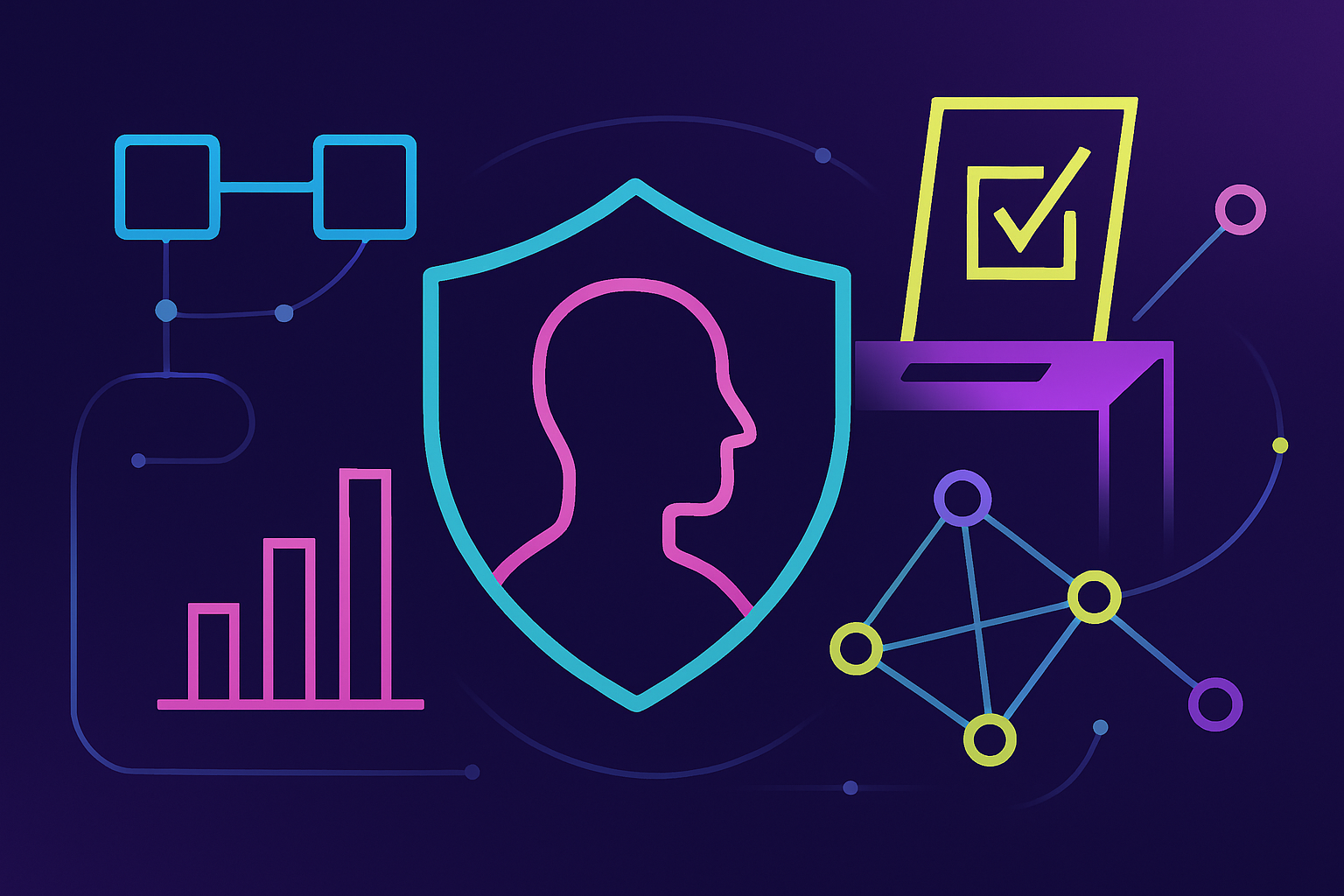
Confidential voting has become a cornerstone for decentralized autonomous organizations (DAOs) striving to balance transparency with the privacy demands of their members. The rise of zero-knowledge proofs (ZKPs) is fundamentally shifting how DAOs approach governance, enabling robust privacy without sacrificing verifiability or trust. In 2025, as DAOs continue to mature, ZKP-enabled voting is no longer theoretical - it is rapidly becoming the gold standard for secure, private decision-making within decentralized communities.
Why Confidential Voting Matters in DAOs
Traditional DAO voting systems have long struggled with the inherent tension between openness and privacy. On-chain voting is transparent by design, making every proposal and ballot visible to the public. While this transparency ensures accountability, it also exposes voters to risks such as coercion, bribery, and social pressure. In high-stakes or controversial decisions, members may abstain or misrepresent their preferences out of fear that their choices could be traced back to them.
Confidential voting mechanisms address these challenges by ensuring that:
- Voter identities remain anonymous, reducing personal risk and promoting honest participation.
- Vote contents are hidden, preventing vote-buying and external influence.
- The tallying process remains auditable, so stakeholders can trust the outcome without seeing individual votes.
This delicate balance is precisely where zero-knowledge proofs excel.
The Mechanics: How Zero-Knowledge Proofs Enable Private DAO Voting
Zero-knowledge proofs are cryptographic protocols that allow a party (the prover) to demonstrate knowledge of a specific fact to another party (the verifier) without revealing any information beyond the truth of the assertion itself. In DAO contexts, ZKPs are typically used in conjunction with advanced encryption techniques such as homomorphic encryption or threshold encryption:
- Anonymity of Voters: ZKPs let participants prove they are eligible voters - for instance, by holding a governance token - without exposing their wallet address or other identifying data.
- Secrecy of Votes: Votes are encrypted when cast. ZKPs then allow verification that each vote is valid (e. g. , within allowed options) without revealing its content.
- Tally Integrity: Homomorphic encryption enables computations directly on encrypted data. Combined with ZKPs, this allows accurate vote tallying while keeping individual votes secret throughout the process.
This architecture ensures that even if all underlying data were exposed, no observer could link votes to voters or deduce individual choices - only aggregate outcomes are revealed.
Pioneering Implementations: Real-World Examples from 2025
The past year has seen several high-profile DAO projects adopt ZKP-based confidential voting at scale:
- NounsDAO’s zk-POPVOTE Integration: In May 2025, NounsDAO deployed Aztec’s zk-POPVOTE system for fully private and secure on-chain voting. This approach addresses both voter anonymity and resistance to coercion by making ballots unlinkable even during audits.
- Kite Protocol for Private Delegation: Launched January 2025, Kite enables private delegation and re-delegation of voting power without exposing relationships between voters and delegates, even delegates do not know who delegated to them.
- Permanently Shielded Voting via Shutter Network and Snapshot: This collaboration uses linear threshold-homomorphic encryption plus ZKPs so that votes remain confidential forever while results can be transparently verified by anyone in the community.
If you want a deeper technical dive into these architectures, see our guide on implementing zero-knowledge proofs for confidential voting in DAOs.
The Benefits: Privacy-Preserving Governance Takes Center Stage
The shift toward privacy-preserving governance using zero-knowledge proofs brings several tangible benefits for DAOs seeking both legitimacy and inclusivity:
- Enhanced Privacy and Security: Voters participate freely without risk of exposure or retaliation, essential for sensitive proposals or activist communities.
- Diminished Coercion and Vote-Buying Risks: Since neither voter identity nor ballot content can be revealed or sold after-the-fact, external manipulation becomes far less feasible compared to traditional systems.
- Bigger Turnout and Richer Debate: Members who might otherwise abstain due to privacy concerns are more likely to engage, strengthening democratic legitimacy within the DAO structure.
While the benefits are clear, the journey to widespread adoption of confidential DAO voting is not without its obstacles. Even as protocols like Shutter, Kite, and zk-POPVOTE demonstrate the technical feasibility of zero-knowledge proofs in live governance settings, DAOs must contend with real-world operational and usability challenges.
Navigating Challenges: Scaling ZKP Voting for Mass Adoption
Implementing ZKP-based voting introduces notable computational overhead. Generating and verifying proofs is resource-intensive, sometimes leading to higher transaction costs or slower voting cycles compared to traditional systems. For large DAOs with thousands of voters, optimizing performance without compromising privacy remains a top priority for protocol engineers.
Another challenge is user experience. Early ZKP voting interfaces were unintuitive, requiring technical knowledge that excluded less savvy members. In 2025, significant progress has been made in abstracting away complexity, yet ongoing education and UX refinement are needed to ensure broad participation. As new DAO members join from diverse backgrounds, accessible onboarding materials and transparent documentation become essential.
Finally, DAOs must continuously balance transparency with confidentiality. While ZKPs hide individual votes and identities, communities still demand assurance that outcomes are fair and manipulation-free. This has led to hybrid approaches where aggregate results are auditable by all while individual ballots remain secret, a model increasingly seen as best practice for privacy-preserving governance.
Regulatory and Compliance Considerations
The rise of privacy-preserving governance also intersects with evolving legal frameworks such as GDPR and global data protection laws. Zero-knowledge proofs offer a compliant pathway for DAOs operating internationally by minimizing exposure of personal data while retaining robust auditability, see recent research on how ZKPs help blockchain projects meet regulatory requirements without sacrificing decentralization.
This regulatory compatibility is especially relevant for DAOs managing sensitive assets or engaging with institutional partners who require strict privacy guarantees. As policymakers pay closer attention to decentralized governance models in 2025, DAOs leveraging advanced cryptography are better positioned for long-term sustainability.
What’s Next? The Future of Confidential DAO Voting
The momentum behind zero-knowledge proof adoption in DAO voting shows no signs of slowing down. With continued innovation in both cryptographic primitives and user experience design, we can expect even more scalable, efficient, and most importantly, confidential governance mechanisms on-chain.
- Interoperability: Expect more cross-protocol collaborations enabling confidential voting across different blockchains and DAO frameworks.
- Sybil Resistance: Emerging solutions will combine ZKPs with advanced identity schemes to prevent vote manipulation by fake accounts without sacrificing anonymity (learn more about balancing verifiability).
- Mobile-Native Voting: SmartphoneDemocracy-style protocols will bring private voting directly to users’ devices worldwide.
If you’re considering implementing these technologies within your own organization or want deeper technical guidance on best practices for privacy-preserving governance, our resources on private DAO voting systems offer actionable insights tailored for 2025’s landscape.
The era of transparent-yet-private decentralized decision-making is upon us, and it’s powered by cryptography that puts community safety first without compromising trust or accountability. As the ecosystem matures further, expect confidential DAO voting via zero-knowledge proofs to be not just an option but a baseline expectation for responsible decentralized governance.




No comments yet. Be the first to share your thoughts!