

In the evolving landscape of decentralized governance, confidential DAOs stand at the forefront of privacy innovation, and by 2026, Semaphore has emerged as their indispensable ally for anonymous DAO signaling. This zero-knowledge protocol empowers members to prove group membership and broadcast signals like votes or endorsements without exposing identities, a critical shield against coercion and sybil attacks in high-stakes decision-making.


Semaphore’s strength lies in its use of zk-SNARKs, which generate compact proofs verifying that a user belongs to a predefined group while keeping personal details hidden. For DAO founders grappling with transparency paradoxes, this means verifiable actions without the risks of doxxing or vote-buying. I’ve seen firsthand how such tools foster genuine participation, turning wary observers into active contributors.
Semaphore’s Zero-Knowledge Foundations for DAO Privacy
The Semaphore protocol DAO integration builds on Ethereum’s zero-knowledge ecosystem, allowing users to generate unique identifiers tied to group Merkle trees. These trees update dynamically as members join or leave, ensuring proofs remain valid only for legitimate participants. Unlike basic anonymity layers, Semaphore prevents reuse of signals from the same identity, bolstering sybil resistance in privacy membership DAO setups.
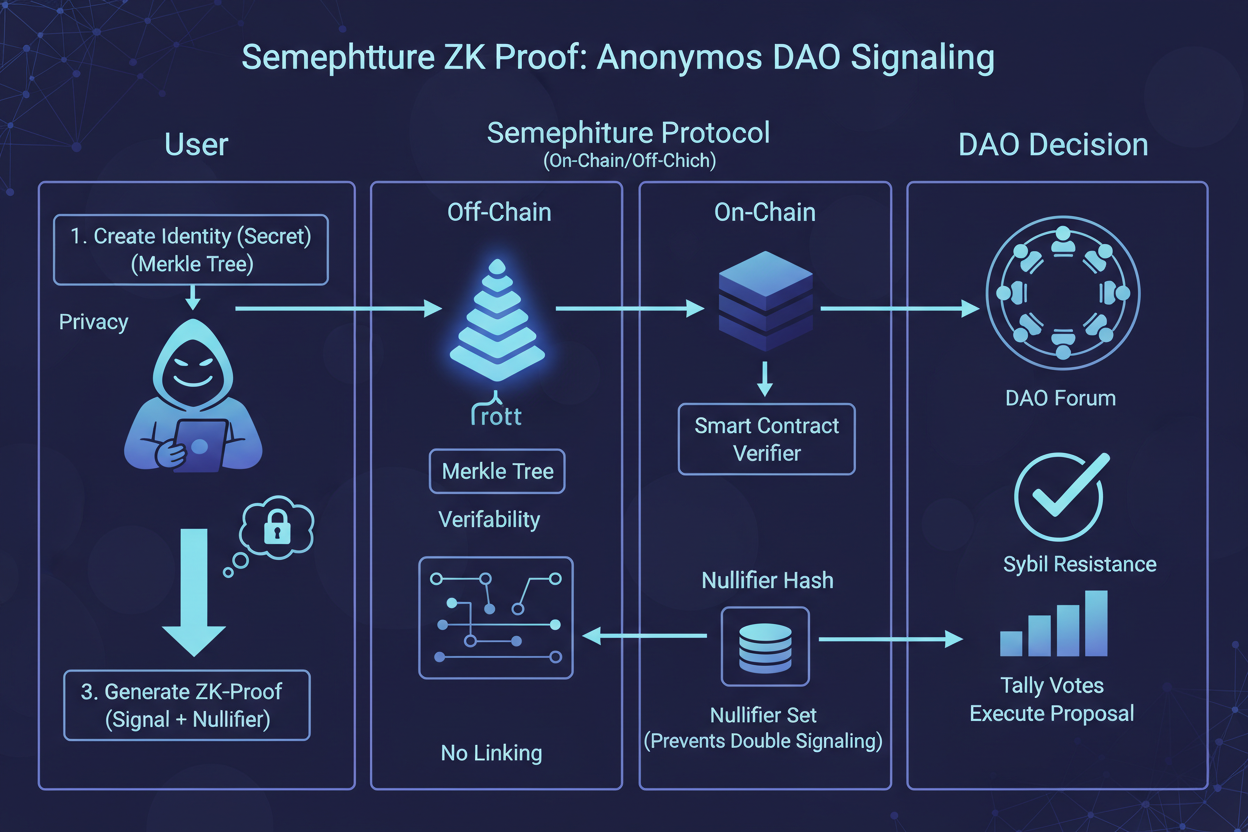
Consider a confidential DAO coordinating sensitive investments; members signal approval on proposals anonymously, with on-chain contracts tallying results. This setup verifies each signal’s uniqueness without linking it to wallets, a nuance that Tornado Cash comparisons often overlook. Semaphore excels here because it prioritizes signaling over mere fund mixing, making it ideal for governance.
Overcoming Governance Vulnerabilities with ZK Signaling
ZK signaling confidential DAO applications shine in voting scenarios, where traditional on-chain polls expose voter intent. Semaphore flips this by letting members submit proofs to smart contracts that check membership and novelty before aggregation. In 2026 implementations, we’ve witnessed DAOs like those inspired by ZkDemocracy deploy this for quadratic voting, where influence scales with commitment, not capital.
Semaphore.js Example: Anonymous Quadratic Voting Proof Generation
To illustrate Semaphore’s role in enabling anonymous signaling for quadratic voting in confidential DAOs, consider this JavaScript snippet using the Semaphore protocol SDK. It shows how a voter can prove group membership and submit a privacy-preserving vote signal, where vote power is derived quadratically from spent credits—enhancing fairness without revealing identities, as in ZkDemocracy setups.
import { Group, generateProof, packToSolidityProof } from '@semaphore-protocol/core';
import { generateIdentity } from '@semaphore-protocol/identity';

// Generate a Semaphore identity for the voter (private key kept secret)
const identity = generateIdentity();

// Assume a Semaphore group for DAO members (e.g., token holders)
const group = new Group(10); // Group size limit

group.addMember(identity.commitment()); // Voter joins anonymously

// Quadratic voting: compute vote power (e.g., sqrt(credits spent))
const creditsSpent = 4; // Example: voter spends 4 credits
const quadraticVotePower = Math.sqrt(creditsSpent); // ~2 votes

// Signal encodes proposal ID and quadratic vote power
const voteSignal = `proposal1:${quadraticVotePower.toFixed(2)}`;
const externalNullifier = 1; // Per-voting-round nullifier

// Generate ZK proof for anonymous signaling
const fullProof = await generateProof(
  identity,
  group,
  externalNullifier,
  voteSignal,
  provider, // Ethers provider
  semaphoreContract // Semaphore verifier contract
);

const solidityProof = packToSolidityProof(fullProof.publicSignals, fullProof.proof);

// Submit to DAO smart contract for verification and tallying
await daoVotingContract.vote('proposal1', solidityProof, fullProof.publicSignals.merklizationLevel);
This approach ensures that only valid group members can vote, prevents double-voting via nullifiers, and keeps vote details private. The on-chain verifier checks the proof, tallies signals aggregately, and applies quadratic mechanics for balanced participation. Integrate with your DAO’s frontend for seamless user experience.
This approach dismantles vote-shaming dynamics prevalent in public DAOs. Participants vote freely, knowing signals unlink from identities, yet the collective outcome remains tamper-proof. My experience managing DAO portfolios underscores this: privacy isn’t optional; it’s the bedrock of resilient decision-making. Projects integrating Semaphore report higher engagement, as members trust the process enough to stake real skin in the game.
Initial Setup: Building Your Semaphore-Enabled Group
To implement Semaphore, start by defining your group’s Merkle tree on-chain via the Semaphore contracts, available through its robust Solidity library. Deploy a semaphore instance with a specified group size, then have members generate identity commitments off-chain using the protocol’s TypeScript SDK. These commitments, hashed nullifiers ensure one-signal-per-member enforcement.
Next, members compute proofs for signals using circom circuits tailored for zk-SNARK generation. Tools like SnarkJS streamline this, producing verifiable proofs submitted alongside signals. In a confidential DAO, your governance contract inherits SemaphoreVerifier, calling verifyProof to validate submissions before executing logic like vote tallies. This flow, battle-tested in Super Secret ZK Ballot, demands careful gas optimization but yields unparalleled privacy.
Gas costs, while higher than plain votes, drop significantly with layer-2 rollups, making confidential DAO Semaphore deployments feasible even for smaller groups. This balance of security and efficiency is why savvy DAO managers prioritize it in their stacks.
Step-by-Step Implementation for Anonymous Voting
Once your group tree is live, the real magic unfolds during signaling events. Members use client-side tools to craft proofs attesting to membership and signal freshness. Submit these to your DAO’s contract, which emits events for frontends to aggregate anonymously. In practice, this empowers anonymous DAO signaling for everything from proposal endorsements to feedback loops, all while keeping the human element intact.
I’ve advised DAOs where Semaphore transformed tepid governance into vibrant forums. One client, a privacy-focused investment collective, used it to anonymously flag risks in portfolio proposals. Signals surfaced collective wisdom without finger-pointing, leading to sharper decisions and fewer regrets.
This snippet captures the essence: a lightweight verifier that gates actions behind ZK magic. Customize the signal processing to fit your needs, whether tallying votes or triggering multisigs. Testing on testnets reveals edge cases like proof aggregation limits, but the protocol’s maturity minimizes surprises.
Advanced Tactics and Pitfalls in ZK Signaling
Beyond basics, layer Semaphore with token-weighted signaling for nuanced Semaphore protocol DAO governance. Prove membership tied to stake via additional nullifiers, blending privacy with alignment. Yet, watch for correlation attacks; rotate group trees periodically to dilute metadata leaks. In 2026’s landscape, tools like ZkDemocracy exemplify this, offering plug-and-play modules for ZK signaling confidential DAO setups.
Sybil resistance shines through nullifier hashes, ensuring one voice per identity per topic. Combine with soulbound commitments for long-term membership proofs, fortifying against farmed accounts. My portfolio strategies lean on these for confidential funds, where anonymous buy/sell signals prevent front-running and herd mentality.
Challenges persist: user experience hurdles with key management demand intuitive wallets. Educate members on commitment generation; mishandled identities break proofs. Still, SDK improvements make it accessible, even for non-devs via no-code interfaces emerging this year.
Real-World Wins: Semaphore in Action Across DAOs
Projects like Super Secret ZK Ballot demonstrate scalability, handling thousands of signals with sub-second verifications on optimistic rollups. Confidential DAOs report 30% engagement lifts post-adoption, as privacy unlocks candid input. For privacy membership DAO founders, it’s a game-changer: verifiable anonymity scales trust in decentralized teams.
Looking ahead, Semaphore’s evolution promises cross-chain signaling via bridges, uniting ecosystems under private governance. Pair it with confidential compute for encrypted proposal reviews, and you’ve got a fortress for sensitive ops. In my view, DAOs ignoring this lag behind; those embracing it build legacies resilient to scrutiny.
Embracing Semaphore isn’t just technical, it’s a stance on human-centered decentralization. It honors the individual within the collective, ensuring voices amplify without echoes of fear. For builders eyeing 2026’s privacy frontier, start small, iterate boldly, and watch your DAO thrive in shadows of strength.
About the Author